This is an excerpt from my 2026 book which is available under the “Get Gary’s Books” menu:
Enterprise networks are incredibly sophisticated and complex systems. They combine hardware and network software that must be scaled for hundreds or thousands of users on campus. There are three adjectives that describe every network if it is in a school or any other business:
- Reliable—The network is available (has high uptime) even if a single component fails (it is redundant) and has backup plans operational.
- Robust—The network must be available to every user who needs it even during times of heavy load.
- Secure—The network and the data stored on it must be protected from unauthorized uses.
Ensuring a network is all three necessitates expertise in network architecture. Decisions must be made about the hardware and software and configuration necessary to meet the system requirements for the project. When undertaking a major upgrade or new installation of a network, the school IT professionals will work with educators and school leaders to define the requirements, then work with the vendor who will plan and install it. Planning is typically quite detailed. For example, when installing WIFI, the network architects will determine where access points are to be installed to ensure the entire campus is covered and dead zones are minimized.
An information technology network is much like other technologies as the expertise needed to design and build it is much more specialized and expensive compared to the expertise needed to manage and operate it once it exists. Consider how an IT system in a school is similar to an automobile. Planning and building require engineers and designers who have detailed expertise and expensive tools, but they are not needed after the automobile exists. Once the network exists, system administrators keep it secure and operational for students, teachers, school administrators and others who use it.
Network installation and upgrade projects are labor-intensive and may cause interruptions in network availability and usually necessitate technicians working throughout the building. To minimize the disruptions caused to teaching and learning, network projects can be scheduled during the times when the school is largely empty of students. The vendors whose engineers plan the installations and upgrades will also have large numbers of technicians available, so projects that require many hours of labor can be accomplished in short periods of time using many workers.
Engineers design and technicians build IT networks. System administrators operate and manage the networks once they are installed. Serious problems are brought to the attention of the engineers who have more complete knowledge of the system to identify a solution, but most functionality can be sustained by individuals who have been properly trained and who have adequate resources.
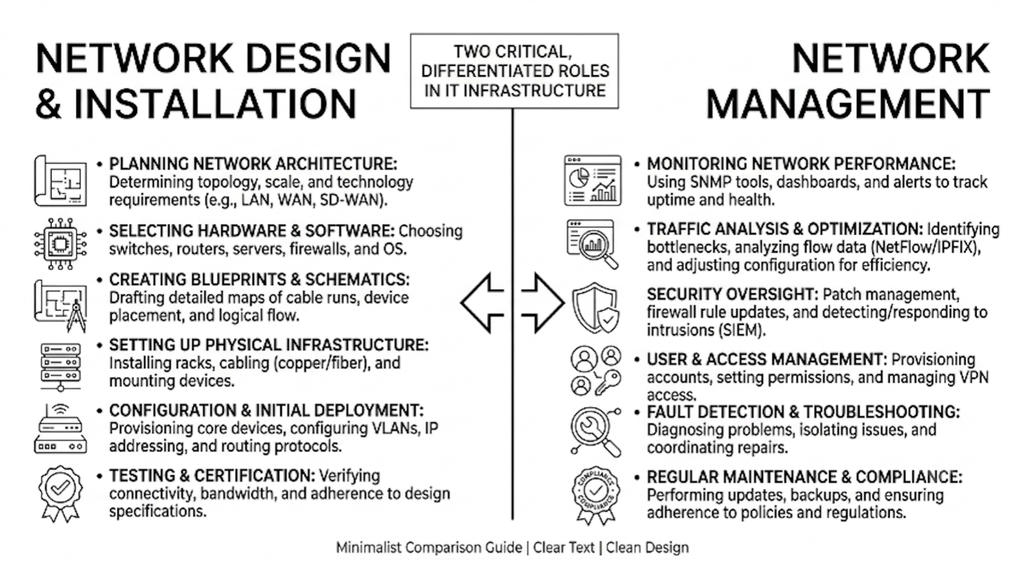
A key aspect of planning and installing a network is mapping and documenting the network. IT networks are very interesting systems. From the inside (when connected to the network on a computer that has network sniffing software installed and running), the network addresses of devices can be located with precision and very quickly, but the physical location cannot be easily determined. From the outside (when looking at the physical device), there is no way to know with certainty its network address or the purpose it serves. A good network map will identify both the network address and physical location of devices (the devices will also be labeled with appropriate information). Most network devices (switches, routers, security appliances, access points, printers, and most other devices which are given static IP addresses) include a web server installed on a small computer in the device. By pointing a web browser to the devices’ IP address, system administrators can log on to a web page located on the device to monitor its operation, change its configuration, update its software, and otherwise manage its operation. This interface can be used to supplement a network map, but it does not replace network documentation.
Network planning, including mapping, is an important part of managing IT resources in schools, but it is often not given the attention that it needs. IT professionals are typically overworked, so they spend much time addressing technology problems that are very pressing; the work of documenting the network can be left undone. While this is seemingly a necessary approach to resolving technology problems in schools, it can lead to greater difficulties later. When outside agencies need to access the network (perhaps because the system administrator is unavailable) or when the school seeks to document network resources and budget for network replacement, a network map can save many hours of work that is billed at a far greater rate than is earned by an IT professional employed by the school.