If you have read recent posts, you will know I have connected with a book written before I was born about the nature of science. In this final post, I continue to reflect on the fact that science depends on two types of knowledge, but that is often ignored in most descriptions of science.
Nash (1963) suggests this cycle to describe that nature of science:
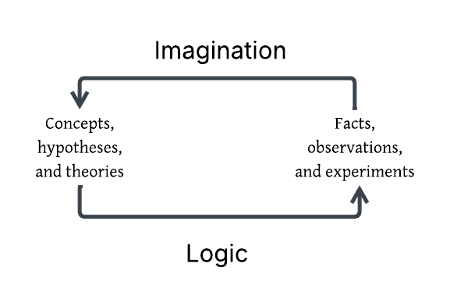
We see imagination is used to take facts, observation, and experiments to create concepts, hypotheses, and theories; while logic is used refine facts, observations, and experiments.
I have always found science (in all its forms) to be a creative process. When we have done science properly, we are able to predict other observations, and those must be logically constructed.
When our predictions are not observed, then we who are scientific check our hypothesis before we conclude the observation was in error. Both are possible.
This is the fundamental difference between those who are scientific and those who are not:
- Our observations may be wrong.
- Our hypothesis may be wrong.
We may not have planned them well enough. We may not have conducted them properly. We may not have analyzed the data properly. These result in our observations being not what we expected.
Our hypothesis is the “thing” we are trying to “prove.” It forms the assumptions we are making about the world, and we have reasoned, “if the hypothesis is true, I should be able to make this observation.”
One sure sign you are following dogma is that your hypothesis is never questioned. When you are following dogma, you cannot be scientific. Regardless of what politicians are saying, you are not being scientific.
Reference
Nash, L. (1963). The nature of the natural sciences. Little, Brown.