This is an excerpt from my recent book, Efficacious Educational Technology: A Guide for School and Technology Leaders. It was published under a Creative Commons license and it can be accessed through this page.
As an education technology professional, you will collaborate with the teachers and educational leaders in schools to ensure the systems you support will support the curriculum and assessment plans necessary to meet the intended standards. You will also collaborate with individual teachers to ensure they can meet their instructional goals.
Meeting teachers’ instructional goals with technology tends to be an individualized endeavor. A teacher will approach the IT staff with a request that they and their students can complete a specific project, and in many cases, they will ask for the “best way” to complete a certain project. In this section, I describe some of the commonly encountered instructional uses of information technology.
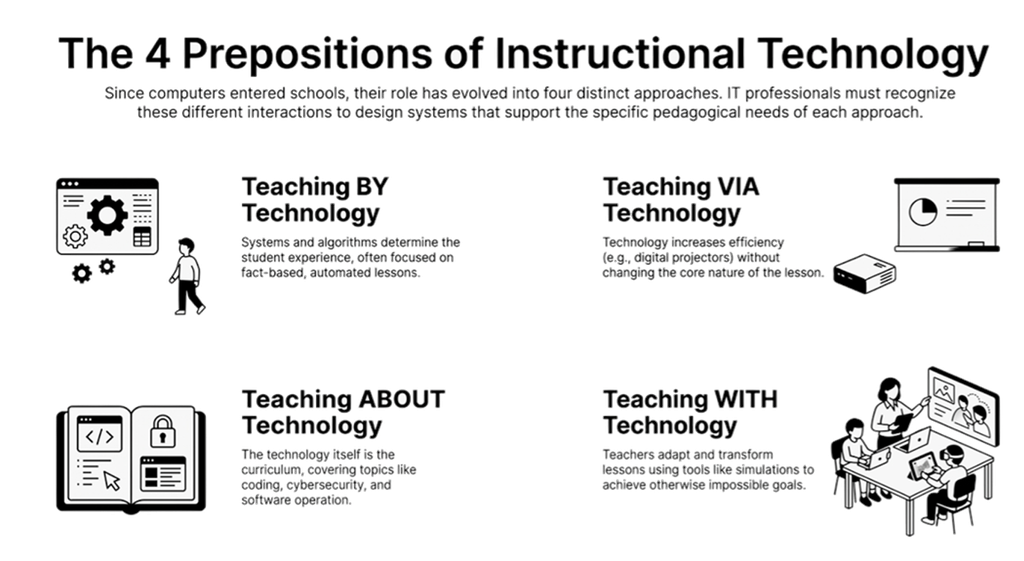
Four Prepositions
Since IT was first introduced into schools, educators have explored the role digital electronic computers should play in teaching and learning. What has become clear is there is no single role that IT should play in schools. Four adjectives can be used to capture the approaches to using technology that have been developed: teaching about, by , via , and with technology. IT professionals must be prepared to recognize each comprises different types of interactions, and they must be prepared to design systems that facilitate each and to support teachers and students engaged in each. Teaching By Technology
When using test-preparation software, skills-building websites, typing tutors, and similar tools, students are experiencing teaching by technology. For previous generations of technology-using teachers, “edutainment” software was a popular method for teaching by technology. This software found students playing games in which they earned points by quickly answering mathematical calculations (for example).
One of the more popular uses of teaching by technology for educators today is the use of test preparation platforms. These are cloud-based and customizable, so teachers can create class lists, define the content they want the system to present to students, and to set other variables. Students log on to the system and work through the lessons selected by the teacher. Later, the teacher can log on to the dashboard and see each student’s progress. Data specialists employed at the school may also access these dashboards to generate reports for various stakeholders, although access to the data in the reports must comply with FERPA protections of privacy.
Most educators recognize this approach is useful for only a limited type of lessons that can be effectively delivered by technology. Once the teachers or other educators define the lessons to be presented, the system and its algorithms (including the errors programmed into it and the biases of the designers) determine the experience for the students. These systems generally rely on students demonstrating learning by providing answers to fact-based questions in which the answers can be clearly identified so it can be evaluated by software. These systems also depend on algorithms to determine what happens when students do not provide the expected answers; sometimes they deliver easier questions, sometimes they direct students to sections for review.
The publishers and vendors who produce platforms for teaching by computers seek to take advantage of the economy of scale. Once the system is produced, they can sell it to many schools and the very substantial development costs are distributed over the many clients. For this reason, these platforms tend to be written to address very general curriculum goals, and in many cases, the vendors seek to influence curriculum decisions, so they create a market for their product regardless of the degree to which the lessons reflect what is needed by the students.
Teaching About Technology
Teaching about technology was common when computers first arrived in educational markets. Called “computer literacy” at the time, it focused on teaching students the names and functions of the components of systems rather than how to use them. Although this has largely been abandoned, this was a very reasonable approach at the time as few individuals had computers in their homes and one of the most important aspects of IT was knowing the system one needed and setting it up to function. Whereas computer users today can purchase systems that automate much of the configuration (for example, when I replaced my years-old printer recently, both my Macintosh computer and my Windows PC recognized the new peripheral and installed the drivers without me taking any action), previous generations of computer users needed to what type of cable connected their peripheral and how to install and configure the driver software to make them operational.
Although teaching computer literacy as described above is not common any longer, many schools continue to teach lessons in which the systems are the curriculum. For example, when teaching lessons about digital citizenship, cybersecurity, and coding, educators are teaching about technology.
Training users how to operate the systems they will encounter is also teaching about technology. Ensuring students know how to use Google Workspace applications, the full text databases available through the school library, and the tools used by math teachers for graphing are examples of teaching about technology within the domain of educators. Ensuring teachers know how to use the student information system, email, and other systems is an example of training within the domain of school IT professionals, and IT professionals are often expected to both deliver training to students, teachers, and other users and prepare how-to articles or videos to support them.
Teaching Via Technology
Teaching via technology describes teaching in which the lesson could be done with or without the technology. The technology may increase the efficiency of some activities, but IT does not influence what students do or how they think about the material being presented.
Consider, for example, a mathematics classroom in which students solve problems on paper. When students review their work in class, the teacher may ask students to show their solutions for all in the class to see. In the 1970’s and 1980’s, my classmates and I carried the paper on which we had done our calculation to the front of the classroom where we transcribed our solution onto the chalkboard for the class to see. I asked my students to do the same when I taught math in the 1990’s (although the board was a whiteboard and students used color markers to write on them). When I was a school technology coordinator, I was asked to purchase a document camera and projector (about $2000 worth of hardware at the time) so that a math teacher could project images of the paper on which students had performed their calculations onto a screen for the class to see. In that case, the experience of doing math was not changed by the technology as students were performing calculation by writing numbers and drawing lines on paper. The students and teacher did avoid the time needed to copy the solutions on to another medium, but the students did not engage with math any differently.
Video content is another example of teaching via technology. Whereas video content was displayed to the entire class at one time before computers arrived in schools (and it still is in many instances), students today often have the option of watching video content on their own. In the 2010’s many teachers explored “flipped classrooms” in which instruction was delivered via video and students watched them for homework, then class meetings were used to solve problems and apply what was taught via video. There are advantages to teaching via technology that do affect how students learn in some cases. If students can access video content away from class (for example when they are doing homework), they can get additional explanations just at the moment they need it, which is advantageous, but the presentation is still like a lecture, and the student cannot get clarification from a video-based explanation.
Teaching With Technology
Teaching with technology has been called technology integration in many sources. This finds teachers incorporating technology into the lessons they would teach without technology. In addition to adopting technology to present the lesson, teachers who teach with technology often adapt their lessons. They will both make planning decisions about the lessons based on the technology tools available and vary the lesson depending on the capacity of the technology.
Consider, for example, the math teacher who decides to use an online graphing calculator rather than graphing on paper. That teacher may be able to introduce more sophisticated graphs more quickly than those who plot functions on paper, or they may be able to create sliders or similar controls that allow students to see how changing those variables affect the plots.
Of the four approaches to technology-based teaching, teaching with technology is the one that necessitates the greatest adaptability from educators and flexibility from IT professionals. Whereas the other approaches are used for lessons in which there are clearly defined educational goals and technology needs, teaching with technology requires design that accommodates many variables including uncertain goals, needs, and customization and individualization of product in which students demonstrate their learning.
One interesting and effective method of teaching with technology is the use of simulations. These are especially effective in mathematics and science education and allow students to participate in otherwise unavailable experiments and demonstrations. Of course, the boundaries between these types of teaching do blur. For example, a biology teacher who uses video to show students footage of underwater ecosystems is probably teaching with technology rather than teaching via technology.